In my previous posts, I’ve been talking a lot about AI technology and tooling, and any enthusiasm within those posts came from helping people see how and where to test AI, and keep it explainable, interpretable, testable and, thus, ultimately trustable. All that content being said, I have serious concerns about what AI is potentially doing to us: not to our test pipelines, but to us as a civilization. Fair warning: this is a bit of a Thomist indictment of techno-oligarchy.

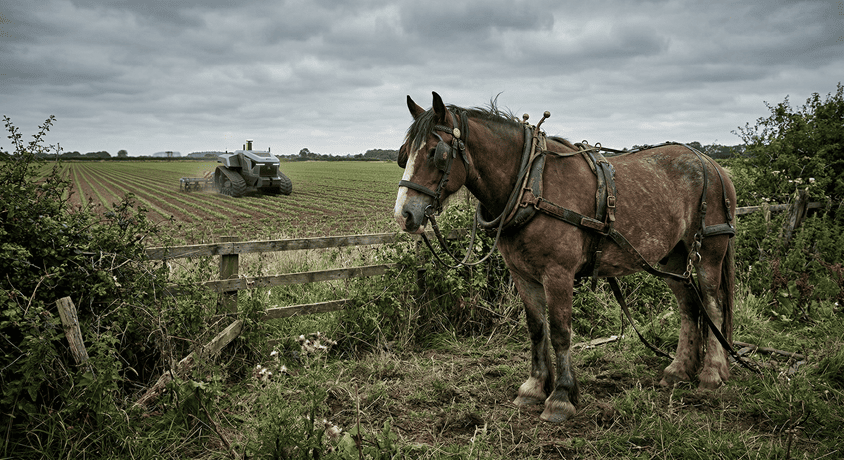
Consider the horse.
In 1900, there were roughly twenty-one million horses in the United States. They pulled plows, hauled freight, carried soldiers, and powered the arteries of commerce in every city and county in the nation. They were, in an economic sense, indispensable.

Then came the internal combustion engine; not as an act of malice, but as an act of optimization. Within fifty years the horse population had collapsed by more than two-thirds. No one hated the horses. No one conspired against them. They were simply no longer necessary, and a system built to optimize for efficiency has no budget line for the unnecessary.
Given that context, here is my question, offered with complete seriousness: are we the horses?
The Anomaly We Mistook for Progress
We tend to think of the twentieth century as the direction history was always heading: rising middle classes, expanding democratic participation, broadly distributed prosperity. But zoom out far enough and that picture looks less like destiny and more like a brief, remarkable exception.
For most of recorded human civilization, the distribution of power and wealth has looked something like a pharaoh and his court at the top, and an enormous base of peasants, serfs, or slaves doing the work of sustaining both. The Roman latifundia, the medieval manor, the plantation economy: these are not aberrations in human history. They are (arguably) the default. What is aberrant, historically speaking, is the notion that ordinary people should own property, participate in governance, and retire with dignity.
That aberration was produced by a specific confluence of forces: industrialization that required a skilled, mobile, and therefore relatively empowered labor force; wars that demanded mass participation and created mass obligation; and democratic institutions that, however imperfectly, held concentrated power partially accountable. None of those forces are permanent. And at least one of them, namely the economic necessity of human labor, is now under direct pressure from artificial intelligence.
The question worth sitting with is not whether AI will change the economy. It already has, and it will likely continue to do so at a pace that outstrips our ability to adapt institutions around it. The question is whether the resulting world will look more like 1965 or more like 1065.
Optimization Without a Telos
It would be convenient if the concern here were simply about greedy people making bad choices. Greed is a moral failing, and moral failings can be addressed: by law, by culture, by conscience. The more unsettling reality is that the system driving these outcomes doesn’t require greedy people to produce catastrophic results. It only requires the system to work as designed.
Corporations are legally and structurally optimized for financial return. This is not a secret or a scandal; it’s the explicit design. Humans appear in that design as line items: as labor costs to be minimized, as consumers to be monetized, as regulatory risks to be managed. When a better tool for producing output comes along (one that doesn’t require benefits, doesn’t unionize, doesn’t sleep), a system built to optimize for financial return will use it. Not out of malice. Out of logic.
Government was, in theory, the counterweight. Democratic institutions exist precisely to assert that human beings have claims on the system that are not reducible to their economic productivity: claims to safety, to dignity, to participation. That function has eroded, not through a single dramatic betrayal but through the slow gravitational pull of money toward political power.
It’s quite clear that most governments in the developed world today do not primarily serve as a hedge against market forces. They serve, in significant degree, as an instrument of them. Now, into this arrangement, introduce a technology that reduces the need for human labor by orders of magnitude.
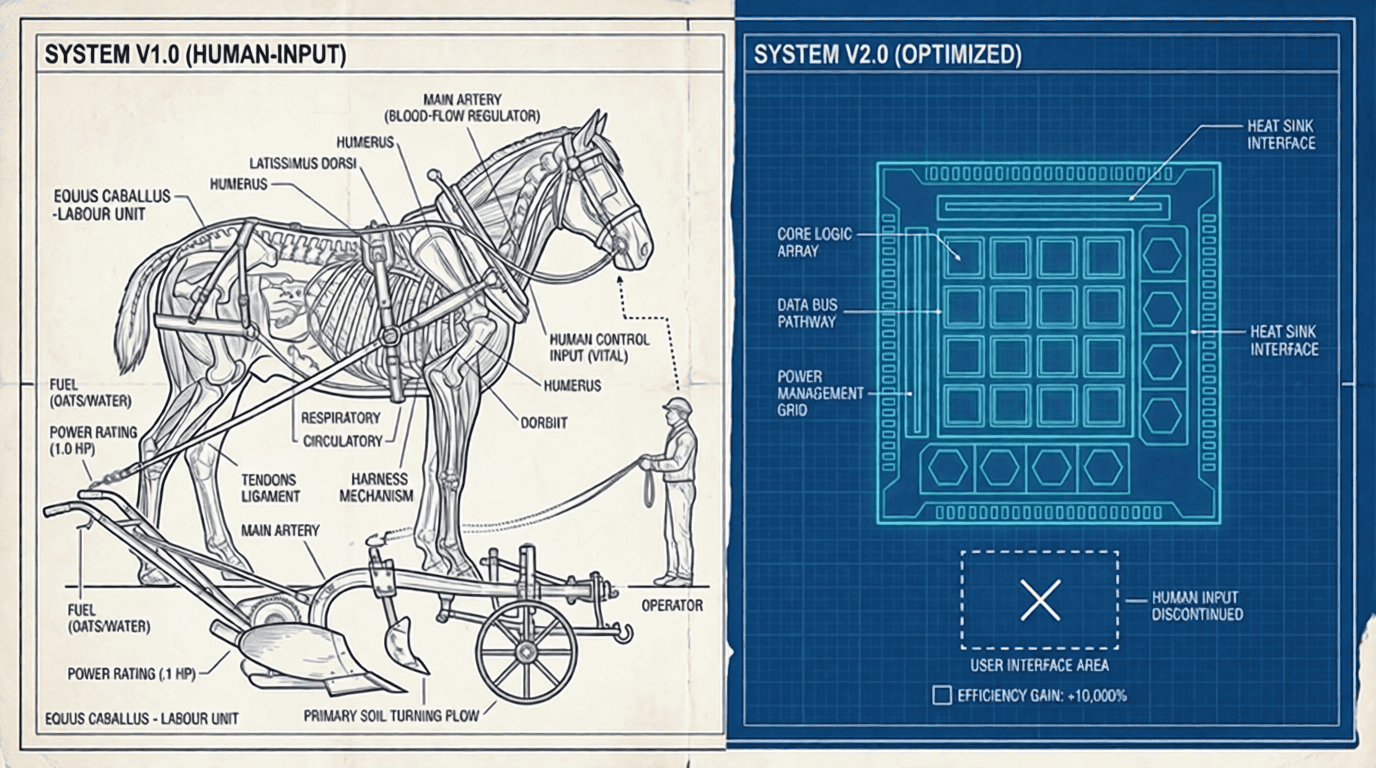
The result is not mysterious. A system designed to extract value, facing dramatically reduced need for human inputs, will extract value with dramatically reduced regard for human outcomes. No villain required.
Okay, so, if the system is working exactly as designed, and the design doesn’t include you … well, then who or what, exactly, do you appeal to?
This is probably how the horses felt. Or at least how they would have felt if horses could feel the particular vertigo of becoming economically redundant in a world that used to depend on them.
The Thomist Interruption
There’s a tradition of political philosophy that’s older than capitalism, older than democracy, and even older than the nation-state. This is a philosophy that would look at this situation and name what is wrong with it in terms that cut deeper than economics.
Thomas Aquinas, building on Aristotle and the broader natural law tradition, argued that human beings have a telos, a proper end, a mode of flourishing that is built into what they are, not assigned to them by the market or the state. I should say plainly that I come to just about everything as a Thomist (more than an Aristotelian, though the debt runs through both,) and I’m aware that framing a political economy argument in medieval philosophical categories requires some justification.
The justification is simply that the framework does real work here, in ways that more fashionable analytical tools don’t. Political communities exist, on Aquinas’s account, not to maximize GDP or even to protect individual liberty in the abstract, but to create the conditions in which human beings can actually flourish as human beings. This is what he called the bonum commune (the common good), and it’s categorically different from the sum of individual preferences or the aggregate of shareholder returns.
From this flows a principle called subsidiarity: the idea that decisions and resources should be managed at the lowest level that is competent to handle them, as close to the affected people as possible. Power that can be exercised locally should not be centralized. Resources that can sustain communities should not be extracted upward into distant corporate structures.
Subsidiarity is not a left-wing or right-wing principle: it appears in religious social teaching and in the instincts of genuine conservatives and progressives alike. It’s simply the recognition that human flourishing happens at the scale of persons and communities, not at the scale of global supply chains.
Measured against these standards, the direction of AI-driven consolidation is not merely economically risky. It is, I would argue, philosophically wrong. When the basic conditions of material life, such as food, shelter, healthcare, and the ability to earn a living, are increasingly controlled by a small number of private actors whose accountability runs to shareholders rather than to persons, the common good is not being served. It’s being privatized.
The horror of the horse scenario is not, seen in this light, an economic horror. It’s a moral one. It’s the treatment of beings with intrinsic dignity as if their dignity were instrumental; as if what they are worth depended entirely on what they can produce. Aquinas would recognize this error. He would call it a failure to respect the proper end of a rational creature.
The Blueprint in Plain Sight
On this broad topic of societal harm, I’ve written about Sam Altman’s proposal before, in more detail and from a quality assurance perspective (Quality Assurance for Society) so I won’t rehearse the full critique here. But the headline findings are worth restating briefly, because they’ve only become more relevant.
In fact, the question of whether AI is currently driving job losses or merely being used as cover for them is itself a live and contested issue that serves as a good data point. A recent piece examining the Jassy and Dorsey layoffs captures the tension well, noting that Altman himself has warned that companies are blaming AI for cuts “whether or not it really is about AI.” That’s a remarkable admission from the CEO of OpenAI. But it also sidesteps the harder question: not whether AI is causing disruption today, but what his own vision guarantees for tomorrow.
In 2021, Altman published an essay titled “Moore’s Law for Everything” that deserves to be read carefully, because it’s one of the more candid articulations of where a certain strain of techno-optimism leads.
Altman’s proposal sounds democratic at first: tax the most valuable AI companies in shares, distribute those shares to every American citizen, and let everyone benefit from the AI-driven wealth creation. “If everyone owns a slice of American value creation,” he writes, “everyone will want America to do better.”
Yeah, sure, but the fine print matters. The tax rate on companies, Altman specifies, must remain smaller than the average growth rate of the companies being taxed. This ensures that distributions to citizens never accumulate to the point of meaningful influence. What’s being offered is not ownership. It’s a managed allowance; just enough participation to create the appearance of equity, carefully calibrated to preserve the reality of control.
By 2024, the vision had evolved further. Altman floated the concept of “universal basic compute.” Here, instead of cash distributions, citizens would receive allocations of AI processing time on OpenAI’s systems, which they could use, sell, or donate. “Owning a unit of a large language model,” he suggested, “could be more valuable than money.”
Now, let’s think carefully about what that sentence means. In Altman’s imagined future, your access to the basic instruments of economic participation would depend on allocations from a private company. This is not a new idea dressed in new clothes. It’s the company town: the nineteenth-century arrangement in which workers lived in company housing, were paid in company scrip, and shopped at company stores. The vision, if such it can be called, has simply been updated for the age of large language models, in the small scale, and wider AI, in the broader strokes. The geographic isolation that once enforced dependency is replaced by technological monoculture. Different mechanism, same structure.
To make it permanent, Altman proposes enshrining the tax arrangement in a constitutional amendment. What reads as democratic protection is, on examination, institutional entrenchment: making it as difficult as possible for future generations to renegotiate the terms.
Now, I’ll grant here that Altman may be entirely sincere. Impact, however, matters more than intent. And the impact of his proposal, followed to its logic, is the permanent, constitutionally protected concentration of economic power in private hands, with citizens as dependent beneficiaries rather than sovereign participants.
Yet, who elected Sam Altman to redesign American democracy? Who elected many of other tech oligarchs to redesign worldwide democracy? And if the answer is nobody elected them for that, then what does it mean that we’re letting them do it anyway?
The Costs We Don’t Count
The material infrastructure of this AI-powered future is already being built, and it’s instructive to notice who bears its costs. Data centers, the physical substrate of large AI systems, consume water and electricity at enormous scale, often sited in communities that had no meaningful voice in the decision. The electricity price hikes that result are distributed across entire regions. The carbon load is shared by everyone. The value created flows upward to shareholders and executives of companies operating at a scale that makes most democratic accountability functionally impossible.
This is subsidiarity violated at the physical level: local communities bearing real costs so that globally consolidated corporations can capture global profits. It’s a small example, but it’s a concrete one, and concrete examples have a way of making abstract arguments legible.
A good example of the legibility would be to consider the story of Ida Huddleston and her daughter, Delsia, who rejected $26 million buyout, yet noting many others did not.
The Question We Keep Deferring
There is a strand in the notes I’ve been thinking through for this article that keeps returning to the same uncomfortable question: do we see this clearly enough, soon enough, to do something about it? Or do we wait until people are hungry?
History offers a dispiriting answer. Meaningful redistribution of power has rarely happened before genuine crisis: before the hunger, before the collapse, before enough people have enough to lose that the activation energy of collective action becomes available. The mechanisms of control that have historically kept populations manageable, such as economic dependence, information asymmetry, tribalism, and exhaustion, are not new inventions. They are very old tools, and they work.
What may be different this time is the speed. Previous technological transitions, such as the agricultural revolution, the industrial revolution, unfolded over generations, giving social institutions some purchase on adaptation. The AI transition is happening within the lifespan of people who are alive right now, working in jobs that may not exist within a decade, in political systems that are not remotely equipped to respond at that speed.
The Thomist tradition would say that the common good is not self-executing. It requires active, intentional effort by people who understand what’s at stake. Subsidiarity doesn’t happen by default; it has to be chosen and defended. The question of whether we are capable of choosing it (with adequate clarity, and in adequate time), is one I’m not confident I can answer.
What I am confident about is that the horse didn’t get a vote.